
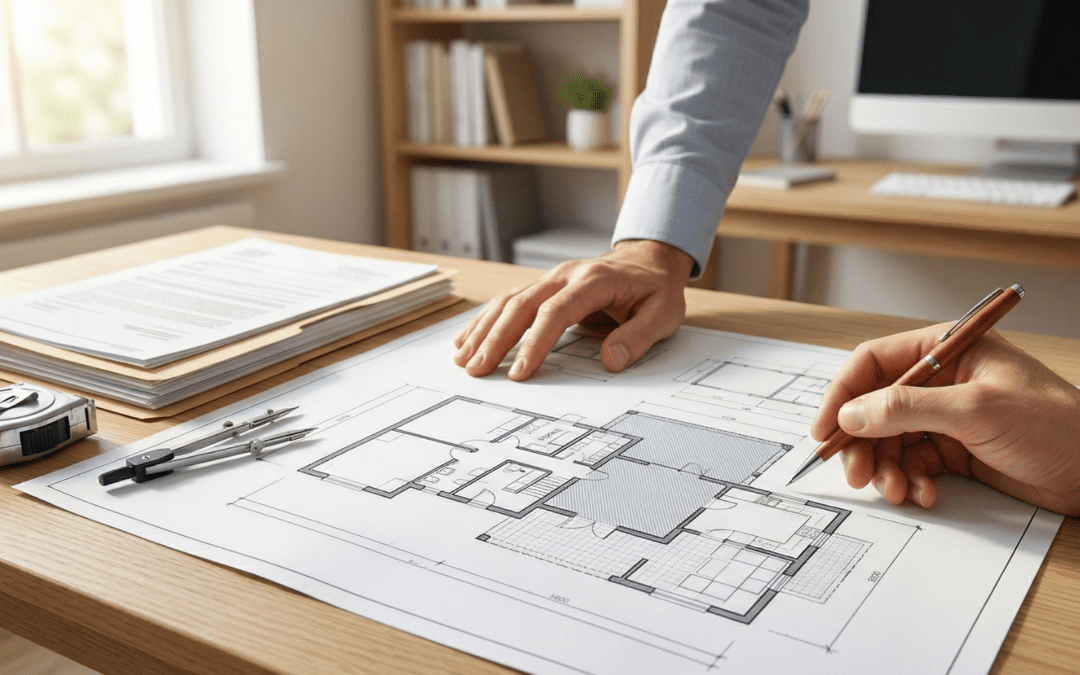
One of the first questions homeowners ask when planning an extension is whether they need council approval. The short answer for most home extensions in the Camden Council area is yes, you need some form of approval. But there are different pathways, and the one you use affects how long the process takes, how much it costs, and how much flexibility you have with the design.
This guide explains the approval options for home extensions in the Camden local government area, which covers suburbs like Camden, Oran Park, Gregory Hills, Spring Farm, Harrington Park, and surrounding areas.
The Three Approval Pathways in NSW
NSW has three main pathways for building approval. Each applies to different types of work based on the size, complexity, and impact of the project.
Exempt Development
Some very small building works do not need any approval at all. These are classified as exempt development under the State Environmental Planning Policy (Exempt and Complying Development Codes) 2008, commonly called the Codes SEPP.
For home extensions, exempt development is limited. Small structures like garden sheds under 20 square metres, minor decks under a certain height, fences, and some pergolas can qualify. But a room addition, a new bedroom, a living area extension, or anything that changes the floor plan of the house will not qualify as exempt development.
In practical terms, if you are adding liveable space to your home, exempt development does not apply.
Complying Development Certificate (CDC)
A CDC is the faster approval pathway. It is issued by a private certifier (also called a registered certifier or accredited certifier), not by the council. The certifier checks your plans against a set of predetermined standards. If the plans meet all the standards, the CDC is approved.
The key advantage of a CDC is speed. Most CDCs are processed within 10 to 20 business days. There is no public notification period and no neighbour objection process.
The key limitation is that your project must fit within strict numerical standards for setbacks, building height, floor space ratio, landscaped area, and other controls. If your extension needs to be closer to a boundary than the standard allows, or taller than the height limit, a CDC will not work and you need a DA.
For home extensions in the Camden Council area, a CDC is the most common approval pathway. Most single storey rear extensions and many second storey additions can be approved this way, provided the design meets all the dimensional requirements.
Development Application (DA)
A DA is the traditional council approval process. You submit plans to Camden Council, the application is assessed by a planner, neighbours may be notified, and the council decides whether to approve the project with or without conditions.
DAs take longer. Processing times vary, but in the Camden LGA you should expect 40 to 90 days as a realistic timeframe. Some complex applications take longer.
The advantage of a DA is flexibility. If your design cannot meet the CDC standards because of site constraints, heritage considerations, or a non-standard design, a DA allows the council to assess it on merit. The council can approve variations to the normal rules if they are satisfied the project will not have unacceptable impacts.
The disadvantage is cost and time. DA fees are higher than CDC fees, the process takes longer, and there is a risk of neighbour objections or council requests for additional information that extend the timeline further.
Which Pathway Applies to Your Extension
For most home extensions in suburbs like Oran Park, Gregory Hills, and Spring Farm, a CDC is the likely pathway. These suburbs have relatively new homes on standard residential blocks with consistent setbacks and lot sizes. The homes were built recently enough that adding an extension within the CDC standards is usually achievable.
In older suburbs like Camden, Campbelltown, and Picton, the blocks are more varied. Some have irregular shapes, narrow frontages, existing structures close to boundaries, or heritage overlays that make a CDC pathway difficult. In these cases, a DA is more likely.
Here are some common scenarios:
Single storey rear extension on a standard block: CDC is usually possible if the extension meets setback, height, and floor space ratio requirements.
Second storey addition: CDC is possible if the addition meets the building height plane, which controls how close the upper level can be to the boundary based on a formula that combines setback and height. Blocks with narrow side boundaries may struggle to meet this requirement.
Extension on a heritage-listed property or in a heritage conservation area: A DA is required. CDCs are not available for heritage-listed properties.
Extension that exceeds the floor space ratio: If adding rooms pushes the total floor area beyond the allowable percentage of the lot size, a DA is needed.
Extension in a bushfire-prone area: Parts of the Camden LGA, particularly toward Picton, Wilton, and the rural fringe, are mapped as bushfire-prone land. Extensions in these areas may require additional bushfire assessment and a DA depending on the bushfire attack level.
What a CDC Requires for a Home Extension
If the CDC pathway applies to your extension, here is what you will need to provide to the certifier.
Architectural plans showing the existing home and the proposed extension, including floor plans, elevations, sections, and a site plan with dimensions to all boundaries.
A BASIX certificate showing that the home (including the extension) meets the energy and water efficiency targets. This is mandatory for all residential building work in NSW.
An engineering report if the extension involves structural changes like removing load-bearing walls, building on a slope, or adding a second storey. The engineer will specify footing designs, beam sizes, and connection details.
A soil classification report if required by the certifier. This determines the foundation design based on the soil type on your block.
Section 7.11 or Section 7.12 contributions (developer levies) may apply depending on the type and size of the extension. These are fees paid to the council to fund local infrastructure and are separate from the CDC application fee.
What Does Approval Cost
CDC application fees for a home extension typically range from $1,500 to $4,000 depending on the value of the work and the certifier’s rates. This covers the application assessment and the construction certificate.
DA application fees are higher. Council fees are calculated based on the estimated cost of the work and can range from $2,000 to $8,000 for a residential extension. Add to this the cost of any additional reports the council requires, such as shadow diagrams, stormwater management plans, or heritage impact statements.
On top of the approval fees, you will need to budget for the plans and reports themselves: architectural drawings ($3,000 to $8,000), engineering ($1,500 to $4,000), BASIX ($500 to $1,000), and any specialist reports.
How to Get Started
The fastest way to find out which approval pathway applies to your extension is to talk to a builder or private certifier who works in the Camden Council area regularly. They will know the local controls, understand the common site constraints, and can tell you early whether a CDC is achievable or whether a DA is the better approach.
Token Building has been delivering home extensions across the Camden and Macarthur region for over 20 years. We handle the approval process as part of the project, working with certifiers and council to make sure the paperwork is sorted before the build begins.
Contact us for a free consultation and we will assess your property and walk you through the approval process.