
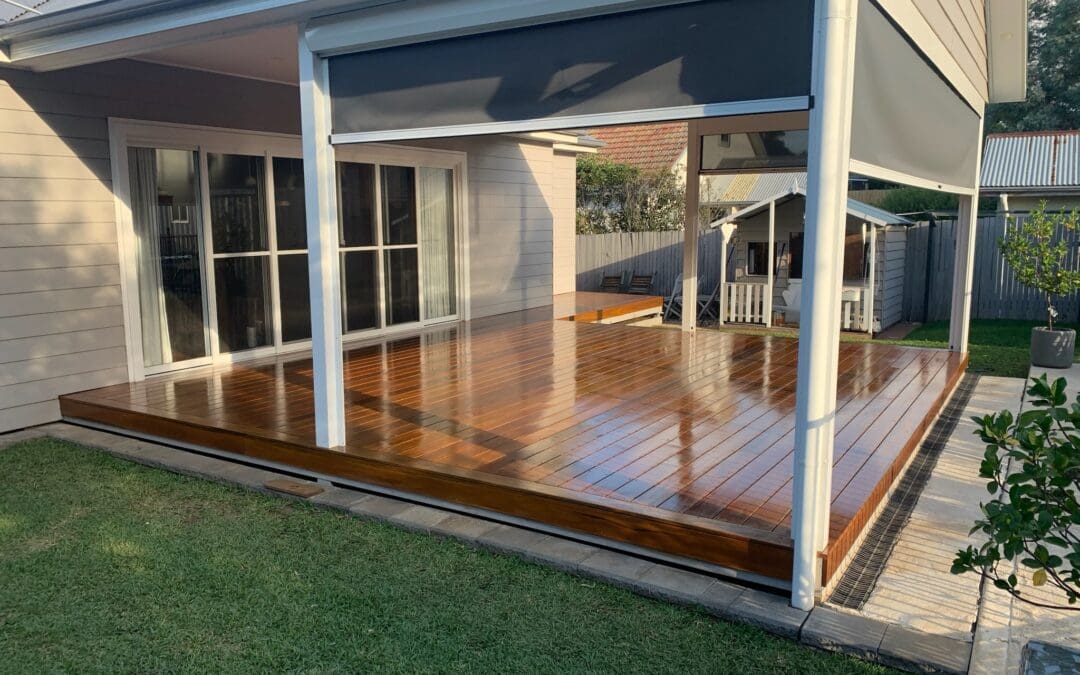
There is a persistent myth among homeowners that small decks do not need council approval. It shows up in Facebook groups, renovation forums, and backyard conversations: “It’s under a certain size, so you don’t need approval.” This is not always true, and getting it wrong can cost you thousands in fines, forced demolition, or problems when you sell.
The rules for deck approval in NSW are not complicated, but they have specific thresholds that most homeowners misunderstand. This guide explains exactly when a deck is exempt from approval, when it needs a Complying Development Certificate (CDC), and when it needs a full Development Application (DA).
The Short Answer
Most decks that families actually want to build, the kind large enough to put a table and chairs on, attached to the house, and raised high enough to step out onto from an indoor living area, need some form of approval. The only decks that are exempt are very small, very low, and unroofed.
Exempt Development: When No Approval Is Needed
Under the NSW State Environmental Planning Policy (Exempt and Complying Development Codes) 2008, commonly called the Codes SEPP, a deck can be exempt from approval if it meets all of the following conditions at the same time.
Height: The deck must not be more than 600mm above the existing ground level at any point. This is measured from the finished surface of the deck to the natural ground level directly below it. On a sloping block, the 600mm limit applies at the lowest point of the ground, which catches many homeowners off guard. A deck that is 400mm above ground at the house end might be 900mm above ground at the far end of a sloping yard, which means it does not qualify.
Size: The deck must not exceed 25 square metres in floor area.
Setbacks: The deck must meet the minimum setback requirements from side and rear boundaries. For most residential zones, this means at least 900mm from a side boundary and at least 900mm from a rear boundary.
Roofing: The deck must not be roofed or covered. If you add a pergola or roof over the deck, it is no longer exempt development regardless of how small or low the deck itself is. The covered structure becomes a separate item that needs its own assessment.
Heritage: The property must not be heritage-listed or located in a heritage conservation area.
Flood or bushfire zones: Additional restrictions apply if the property is mapped as flood-prone or bushfire-prone land. In parts of the Camden and Wollondilly local government areas, particularly near creek lines and toward Picton and Wilton, these overlays can disqualify a deck from exempt development even if it meets all other criteria.
Cumulative area: If you have previously built other exempt development structures on the property (sheds, pergolas, carports, other decks), the combined floor area of all exempt structures must not exceed the total exempt development allowance for your lot. Building multiple small structures to avoid approval is not a loophole the legislation overlooks.
If your deck meets every one of these conditions, you can build it without any approval. But in practice, most family-sized decks fail at least one test, usually the height threshold or the roofing exclusion.
The 600mm Rule: Where Most Homeowners Get Caught
The 600mm height limit is the most commonly misunderstood rule. Here is why.
Most homes in the newer estates across Oran Park, Gregory Hills, and Spring Farm have their internal floor level set 200 to 400mm above the finished ground level at the rear of the house. The back door opens onto a step down to the yard.
To build a deck that you step out onto from inside (level with the internal floor), the deck surface needs to be at the same height as the interior floor. If your floor is 350mm above the ground at the house wall, the deck is already 350mm high before you even get to the far edge.
If the yard slopes away from the house by even 250mm over the length of the deck, the far edge is now 600mm or more above ground. That single condition pushes the entire project out of exempt development and into the CDC or DA pathway.
On established blocks in Camden, Campbelltown, and Mount Annan where older homes often sit higher off the ground, the internal floor can be 500 to 800mm above the rear yard. A deck level with the back door is automatically above the 600mm exempt threshold.
This is why most real-world decks need approval. The heights that make a deck functional (level with the house floor, high enough to feel connected to the indoor living space) are almost always above the exempt limit.
Complying Development Certificate (CDC): The Faster Pathway
If your deck exceeds the exempt thresholds but meets the CDC standards in the Codes SEPP, you can get approval through a private certifier without going to council. This is faster and simpler than a DA.
A CDC for a deck is typically processed within 10 to 20 business days. The certifier checks your plans against the predetermined standards and issues the certificate if everything complies. There is no neighbour notification and no public exhibition period.
To qualify for a CDC, your deck must meet all of the relevant provisions in the Codes SEPP, including setbacks from boundaries, building height limits, floor space ratio limits, and landscaped area requirements. The specific numbers depend on your lot size and your residential zone.
For most standard residential blocks in the Macarthur region, a CDC is achievable for decks that are above 600mm but below approximately 3 to 3.5 metres in height, set back at least 900mm from side boundaries, and do not push the total built footprint beyond the site coverage limit.
What you need for a CDC application:
- Architectural plans showing the deck design, dimensions, and height above ground at all points
- A site plan showing the deck position relative to boundaries and existing structures
- Details of the balustrade design (required for any deck more than 1 metre above ground)
- A BASIX certificate if the deck is attached to the house and triggers the BASIX threshold
- Structural engineering details if the deck is elevated or supporting a roof structure
CDC costs: Application fees typically range from $1,500 to $3,000 depending on the value of the work and the certifier.
Development Application (DA): When You Need Council
A full DA through your local council is required when the deck cannot meet the CDC standards. Common reasons include:
- The deck is on a heritage-listed property or in a heritage conservation area
- The design does not comply with setback requirements (for example, the deck needs to be closer to a boundary than the CDC allows)
- The property has a planning overlay (flood, bushfire, or environmental) that excludes CDC approval
- The deck is part of a larger project that already requires a DA
DA processing times vary by council. In the Camden LGA, expect 40 to 90 business days as a realistic range. Complex applications or those that receive neighbour objections can take longer.
DA costs: Council fees are calculated based on the estimated cost of the work. For a deck project valued at $15,000 to $30,000, DA fees are typically $2,000 to $5,000. Add to this the cost of any additional reports the council requests.
Balustrade Requirements
Regardless of the approval pathway, the Building Code of Australia requires a balustrade (a barrier or railing) on any deck where the fall height exceeds 1 metre. The balustrade must be at least 1 metre high and must not have openings that allow a 125mm sphere to pass through (to prevent children from getting stuck or falling through).
For decks between 600mm and 1 metre above ground, a balustrade is not legally required but is recommended for safety, especially for families with young children.
Balustrade design and material choices (timber, steel wire, glass) affect both the cost and the visual impact of the deck. Your builder can advise on which option meets the code requirements while suiting the look of your home.
What Happens if You Build Without Approval
Building a deck without the required approval is not a grey area. It is a breach of the Environmental Planning and Assessment Act 1979. The consequences include:
Council orders: Your local council can issue an order requiring you to demolish the deck, modify it to comply, or obtain retrospective approval. Retrospective approval is not guaranteed and is often more expensive and difficult than getting approval before you build.
Fines: Penalties for unlawful building work in NSW can reach tens of thousands of dollars for individuals and more for companies.
Insurance issues: If someone is injured on an unapproved deck, your home insurance may not cover the claim. Insurers can void coverage for structures built without the required approvals.
Sale complications: When you sell your property, the conveyancing process includes checks on building approvals. An unapproved deck can delay or derail a sale, reduce the sale price, or require you to obtain retrospective approval or demolish the structure before settlement.
The cost of getting proper approval upfront ($1,500 to $5,000) is a fraction of the cost of dealing with any of these consequences.
How to Find Out What Your Deck Needs
The fastest way to determine your approval pathway is to talk to a builder or private certifier who works in your area. They can measure the height above ground, check the setbacks, review any planning overlays on your property, and tell you whether your deck qualifies as exempt development, can go through a CDC, or needs a DA.
Token Building handles the approval process as part of every deck build across the Macarthur region. We work with certifiers and council regularly and manage the paperwork so you do not have to navigate it yourself.
Contact us for a free consultation and we will assess your property and walk you through the process.