
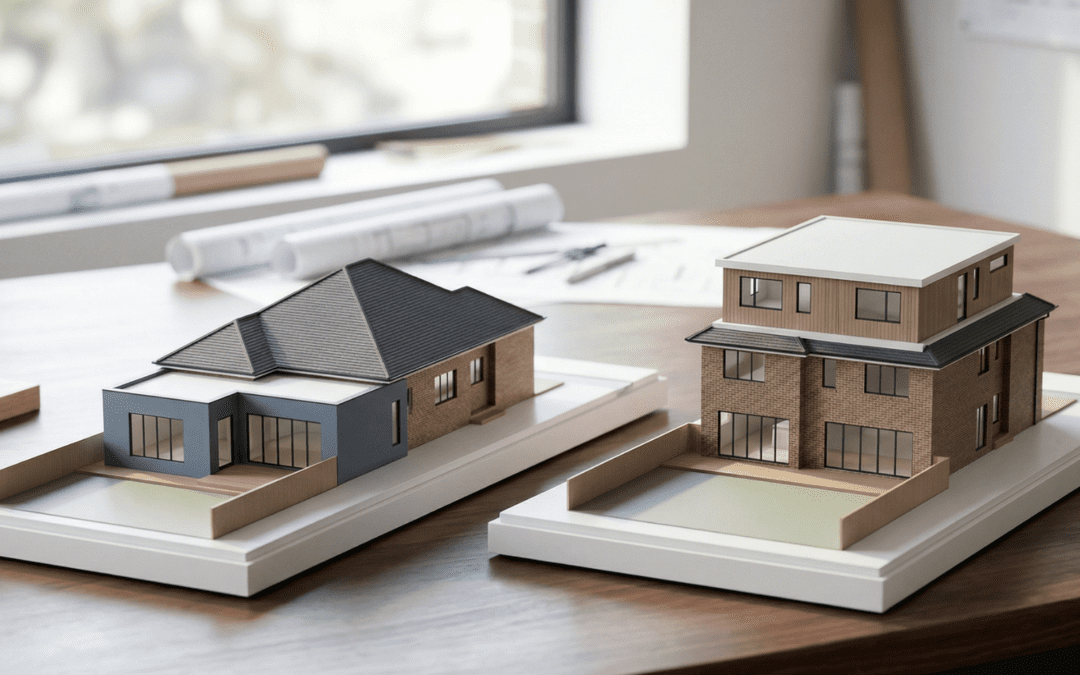
When your family needs more space, the direction you build matters as much as what you build. Going outward with a single storey extension and going upward with a second storey addition are fundamentally different projects. They cost different amounts, take different timelines, affect your property differently, and add different levels of value.
This guide compares the two options across the factors that matter most: cost, property value uplift, construction impact, and which one suits different types of blocks and homes in the Macarthur and South West Sydney region.
How the Costs Compare
Single storey extensions are almost always cheaper per square metre than second storey additions. The reasons are straightforward.
A ground floor extension sits on new footings poured at ground level. The framing connects directly to the existing structure. The roof ties into the existing roofline or uses a simple flat or skillion design. Access for materials and tradespeople is easy because everything is at ground level.
A second storey addition requires structural reinforcement of the existing ground floor. The existing walls, footings, and frame need to be strong enough to carry the weight of a new level above them. In many cases, the existing footings need underpinning, steel beams need to be installed, and the ground floor frame needs bracing. This structural work adds significant cost before you even start building the new rooms above.
Here are the typical cost ranges in the Macarthur region for a mid-range finish level.
Single storey extension (30 to 50 sqm): $80,000 to $180,000. The lower end covers simple bedroom or living area additions. The higher end covers extensions that include wet areas like a kitchen or bathroom.
Second storey addition (60 to 100 sqm): $200,000 to $450,000. The wide range reflects the differences in structural work required, the number of rooms, and the complexity of the stair design and connection to the ground floor.
On a per-square-metre basis, single storey extensions typically cost $2,500 to $3,800. Second storey additions typically cost $3,200 to $5,000 or more, with the structural reinforcement adding $500 to $1,200 per square metre to the base build cost.
How Much Value Each Option Adds
Both extension types increase your property value, but the return on investment differs.
Single storey extensions add value in proportion to the liveable space they create. A well-built rear extension that adds an open plan living and dining area can increase a property’s value by 10 to 15 percent of the pre-extension value. In the Macarthur market, where median house prices sit around $850,000 to $1,000,000, that translates to roughly $85,000 to $150,000 of added value for a project that might cost $100,000 to $160,000.
Second storey additions add a larger absolute amount of value because they add more floor area. Converting a three-bedroom, one-bathroom single storey home into a five-bedroom, three-bathroom two-storey home can increase the property value by 20 to 35 percent or more. On a home worth $850,000, that could mean $170,000 to $300,000 of added value.
However, the return on investment (value added divided by cost spent) tends to be similar for both options, usually sitting between 1.1 and 1.5 times the build cost in a strong market. The key variables are the quality of the build, the local market conditions, and whether the finished home suits the expectations of buyers in that suburb.
In growth suburbs like Oran Park and Gregory Hills, where most homes are single storey, a second storey addition creates a standout property in the street. This scarcity factor can push the value uplift above the average because buyers in these areas have very few two-storey options that are not brand new builds.
In established suburbs like Camden and Campbelltown, where two-storey homes are more common, the value uplift from going up is less dramatic because buyers have more comparable options to choose from.
How Each Option Affects Your Block
Single storey extensions eat into your yard. If you extend the back of the house by 6 metres, you lose 6 metres of backyard. On the 350 to 500 square metre blocks common in South West Sydney’s newer estates, that can mean losing a significant portion of the outdoor space.
This matters because outdoor space has its own value. A family home with a tiny backyard is less appealing to buyers than one with a usable yard, a deck, or room for kids to play. There is a tipping point where extending the house reduces the overall appeal by making the block feel cramped.
Council controls reinforce this. Most residential zones require a minimum percentage of the lot to remain as landscaped area. In the Camden LGA, this is typically 30 to 40 percent depending on the zone and lot size. If your block is small, a large ground floor extension may not be possible without breaching this requirement.
Second storey additions preserve the yard. You build above the existing footprint, so the outdoor space stays the same. For families who value their backyard, their outdoor living area, or their pool space, going up keeps all of that intact.
The trade-off is height and bulk. A two-storey home casts more shadow on neighbouring properties, and the building height plane rules in the CDC standards limit how close the upper level walls can be to side and rear boundaries. On narrower blocks, meeting these height plane requirements can restrict the size of the upper floor.
Living Through the Build
The construction experience is different for each option, and for many families this is a deciding factor.
Single storey extensions can often be built while you stay in the house. The new rooms are constructed alongside or behind the existing home, and the internal connection is only made toward the end of the project. There will be noise, dust, and disruption, but you can usually keep using your kitchen, bathrooms, and bedrooms throughout.
Second storey additions are more disruptive. The existing roof needs to be partially or fully removed. Structural work happens inside the existing home, which may involve propping up ceilings, reinforcing walls, and cutting into the ground floor structure. Most families need to move out for at least part of the build, typically four to eight weeks during the most intensive structural phase.
The build timeline also differs. A single storey extension usually takes 12 to 20 weeks from slab to handover. A second storey addition typically takes 20 to 32 weeks because of the additional structural work, the complexity of working above an existing home, and the coordination of trades working at height.
Which One Suits Your Situation
The right choice depends on your block, your budget, and your priorities. Here is a simple framework.
Choose a single storey extension if you have enough yard space to lose without making the outdoor area too small, your budget sits between $80,000 and $180,000, you want to stay in the home during the build, and you need one or two extra rooms rather than a complete reconfiguration of the house.
Choose a second storey addition if your block is too small to extend outward without losing the backyard, you want to add multiple bedrooms and bathrooms, your budget supports a $200,000 to $450,000 project, and you want to create a standout property that separates itself from other homes in the street.
Consider combining both if you have the budget and the block allows it. Some of the best extension projects we have done involve a modest ground floor extension to open up the living areas, combined with a partial second storey to add bedrooms and a bathroom above. This hybrid approach maximises the new space while keeping the overall footprint balanced.
Talk to a Builder Who Has Done Both
Token Building has designed and built both single storey and second storey extensions across the Macarthur region. We can assess your block, walk you through the structural requirements, and give you honest advice on which approach will deliver the best result for your family and your budget.
Book a free consultation with our team and find out what is possible for your home extension.